
Strava Reports 50% Bonk Rate at 2025 London Marathon Amid Unseasonable Heat
The 2025 London Marathon, held on April 27, witnessed a significant slowdown among runners, with over half experiencing a “bonk“—a term used when athletes slow down by 10% or more in the second half (Claim: Strava). This data, provided by Strava, the global fitness tracking platform with over 150 million users, highlights the challenges participants face this year.
Heatwave Hits the Marathon

A primary factor contributing to the increased bonk rate was the unseasonably warm weather and likely poor thermoregulation by many inexperienced athletes. Race day temperatures peaked at approximately 22°C to 23°C (71°F to 73°F), a notable rise from the previous year’s cooler conditions, which ranged between 7.3°C and 11.1°C (45°F to 52°F). The Met Office had forecast these warmer conditions, advising runners to prepare accordingly.
As you can see from the table above, in these conditions, runners of the 3-hour standard would need to adjust their target pace by 6 seconds/km.
Sensible tech-lovers of this site might also have used a Core 2 Body temperature sensor and kept their efforts in Zone 2, like Kristian Blummenfelt recently won in Texas.
https://www.instagram.com/p/DI_GMeCIQJW/
Performance Metrics Decline
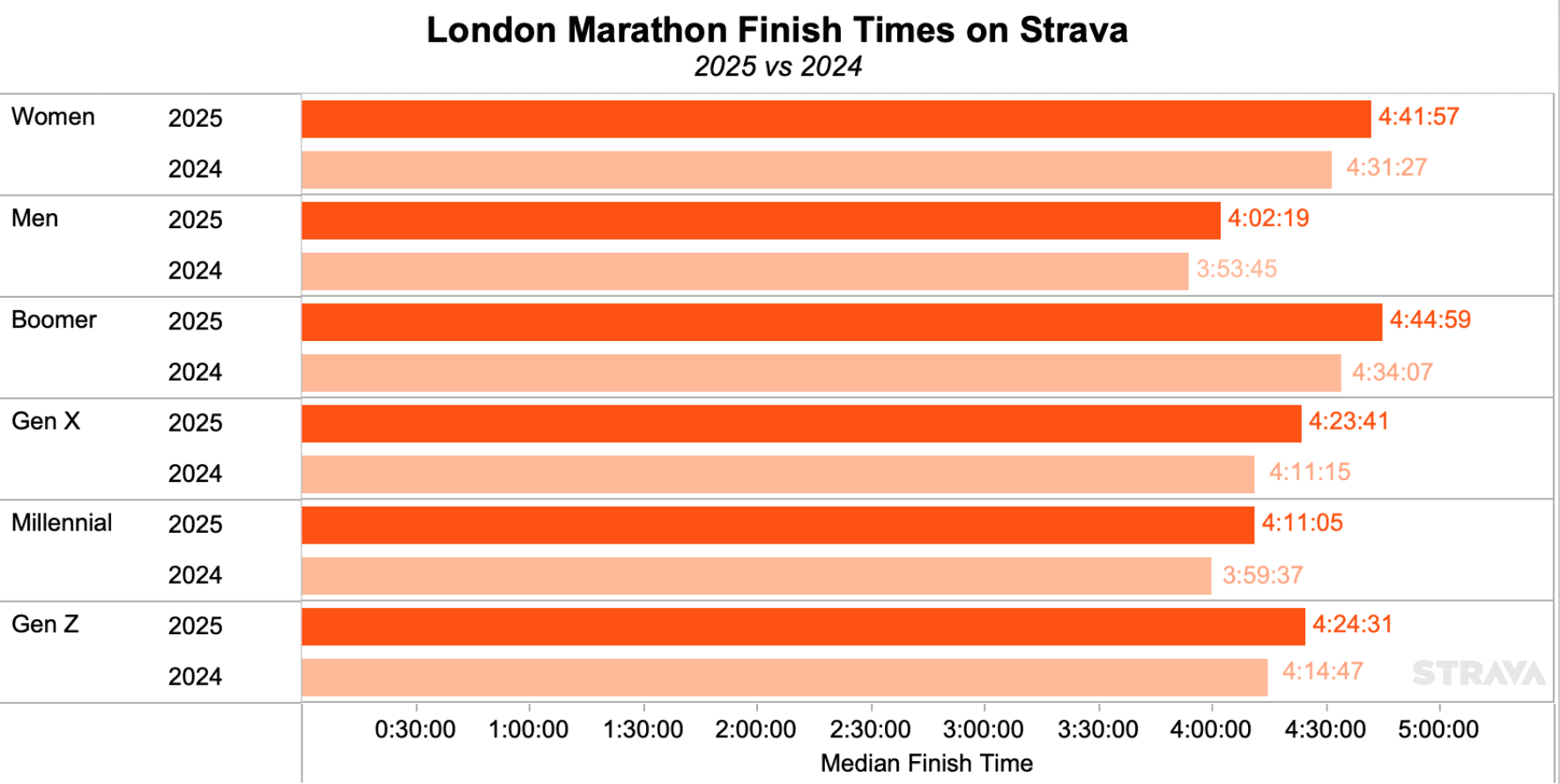
Strava’s analysis revealed that average finishing times in 2025 were slower across all demographics compared to 2024. Specifically:
- Women: On average, female runners completed the marathon over ten minutes slower than the previous year.
- Men: Male participants averaged finish times exceeding 4 hours, compared to 3 and 53 minutes in 2024. (at least 6 minutes slower)
- Generational Impact: Millennials and Generation X runners experienced the most significant decline, averaging 12 minutes slower, while Generation Z and Baby Boomers were approximately 10 minutes slower.
The 5th kilometre emerged as the fastest race segment, with an average pace of 5:20 minutes per kilometre. This indicates that many runners started strong before succumbing to the heat in later stages.
Compare those declines in performance to the declines indicated above due to temperature. I contend that better temperature-adjusted pacing would have meant some athletes were only 3 minutes slower than hoped, rather than the 6 minutes we saw.
Elite British Performances
Despite the challenging conditions, several British athletes delivered noteworthy performances:
- Mahamed Mahamed: The top British finisher in the men’s elite race, Mahamed secured 9th place with a time of 2:08:52.
- Alex Yee: Making his marathon debut, Olympic triathlon champion Alex Yee finished 14th overall with a time of 2:11:08. Yee started with a strong first half, clocking 1:04:19, and was paced through the initial 30km by fellow British triathlete Hugo Milner. Despite facing physical challenges in the latter stages, Yee was pleased with his performance.
- Eilish McColgan: In the women’s elite race, McColgan finished 8th, setting a new Scottish women’s marathon record with a time of 2:24:25. This performance surpassed the previous national record held by Stephanie Twell and bettered the personal best of her mother, Liz McColgan, who won the London Marathon in 1996.
I was a Marshall on the course. It was sunny and hot. I had to stand there for several hours, calling and encouraging. I worked up a bit of a sweat and even had to walk back and forth a bit. Yes, us Marshalls had it absolutely brutal on the day 😉
I thought “Bonk” is a cycling term. Runners might say “blew up” or “hit the wall”.
Applies to any endurance sport but mainly cycling and long distance running.
it’s the term Strava used
I also added to the info they press released. The reason for the ‘issues’ was probably linked to temperature/thermoregulation rather than carb depletion.
people also use the term bonked when they mean ‘blown up’ or redline failure ie anaerobic exhaustion. that’s not relavent here tho probably
A friend of mine said they were in the starting pens for 90 mins prior to the start without any shade, and it was mega hot there…he felt that had a big impact on core temperature and he never really got that down.
Great point about the weather potentially impacting the overall median times reported by Strava for London 2025 – definitely a key factor! It’s always interesting to compare different data sets. We ran an analysis on the users of the AI training platform, TrainAsONE, and observed their median times were consistently faster across demographics than the reported Strava figures. Our article explores potential reasons, including the nature of an AI-focused training group vs a broader platform. For those interested in another perspective on the day’s performance data you’ll have to visit the articles section of the TrainAsONE website as it seems that the comments system does not let me post a link… 🙁
i’m feeling nice today – a link to your link: https://trainasone.com/training/london-marathon-2025-trainasone-vs-strava/
Interesting, but number of statistical group size is missing…