

Elite Athletes: Your Garmin HRV Readings May Be Wrong
Heart rate variability (HRV) is a widely used metric for tracking recovery, training readiness, and overall health. Garmin and other wearables provide overnight HRV readings, but for elite athletes—especially those with a low resting heart rate (RHR)—these readings may not be as reliable as they seem. Research suggests that HRV can decrease at low heart rates due to a physiological saturation effect, leading to potential misinterpretation of training readiness.
Understanding HRV and Parasympathetic Saturation
HRV is often associated with parasympathetic (vagal) activity, where higher HRV generally indicates better recovery and autonomic balance. However, studies have shown that the relationship between HRV and parasympathetic activity follows a non-linear, quadratic pattern. Initially, HRV increases as parasympathetic activity rises, but once a threshold is reached, HRV begins to decrease despite continued parasympathetic dominance.
Parasympathetic saturation is particularly relevant for well-trained athletes with RHRs below 55 bpm, where HRV may appear suppressed despite strong vagal tone. A study published in Circulation (Goldberger et al., 2001) demonstrated this effect, showing that HRV does not always linearly reflect autonomic function.
More: EVERYTHING you need to know about HRV – and it’s correct too 🙂
Why Nocturnal HRV May Not Work for Athletes
Garmin and other wearable brands typically track HRV during sleep using methods like the root mean square of successive differences (RMSSD) – Apple uses SDNN.
While valid for general users, this approach may misrepresent recovery status in elite athletes due to:
- Saturation Effects: Athletes with low RHR may experience artificially low HRV, leading to inaccurate readiness assessments.
- Interindividual Variability: The HRV-parasympathetic relationship varies significantly among individuals, making absolute HRV values less meaningful.
- Lack of Context: Sleep HRV reflects overall health rather than immediate training stress or fatigue, which are better assessed using post-wake measurements.

A Better Approach: Post-Wake HRV Readings
HRV experts like Andrew Flatt and Marco Altini (HRV4 Training) recommend measuring HRV in a seated or standing position after waking rather than relying solely on nocturnal readings. Post-wake HRV offers:
- A better reflection of acute stress and fatigue
- Less influence from parasympathetic saturation effects
- More actionable data for training adjustments
Anecdotally, nocturnal-HRV is a decent wellness measure, and waking-HRV is a go-to athletic measure.
Key Takeaways for Elite Athletes
Do it properly, or don’t do it at all.
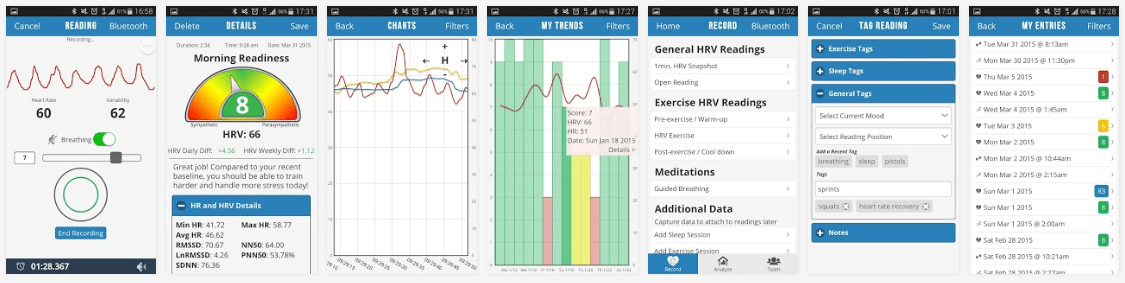
Use EliteHRV, HRV4Training, or something similar and build your HRV baseline with a Polar H10, connected over Bluetooth to an app like HRV4Training or EliteHRV. Base your measurement on one to three minutes of sitting in bed before getting up.
FWIW: That’s what I’ve done for over 15 years! I’m not an elite athlete, but my HRrest is below 55bpm, and I take sport and recovery seriously.
More: HRV4Training , EliteHRV
The fact that they average them over your entire night of sleep and keep a rolling average is a sign that Garmin is aware of high level of noise and error in the system. My sense is it is useful as a reasonable signal for detecting unproductive physiological stress. It tracks well with infections, drinking, and emotional stress in my experience.
I would not use it to direct training for anyone let alone an elite athlete.
yes, it’s valid afor wellness-type measurements and inferences
Great insights and content as always – what is your view on mySASY?
https://www.mysasy.com/
I have heard of it but my knowledge stops there.
if you know more about it please write here. I don’t mind info about competing products when the article isn’t especially about a particular product.
If you are from the company (please say so).
I try the solution since several months, coming from a natural science background it looks easy to use with fast algorithms and solid in prediction/ judgement plus takes TSS from TP into account. Overall, for me actually it is one of the best (most scientific accurate) HRV solutions out. Thats why a comparison of solutions would be really great. And no I habe no commercial nor other connection to them 😉 Only downside is the not 100% matching translation to German. Potentially in English the app is more ‚fluent‘.
why would it take TSS into account?
External load and how your body handles it are different. It’s good to know both and there might be a corellation but they should not be combined into a composite metric ie they are not additive
as someone with an RHR of 38, i have found garmin HRV to be a pretty reliable indicator of my recovery status from training, sickness, work stress etc. much more useful than RHR itself as with such a low RHR the differences in the reading become quite subtle.
its certainly not a perfect way of doing it but it is a practical approach to getting meaningful readings every night which should only ever be one input in guiding your actions.
night time readings are normally less accurate, being subject to more outside influences than waking ones
I recently ditches my forerunner 965 and bought a Suunto Race S.
I’m by no means an elite athlete, but I do run 60k+ a week and my rhr is below 50 and my age is over 50.
I do observe some differences between HRV of the garmin and the suunto.
Garmin reports in the 45 – 85 range. Mostly in the 45 -65 range with some strange increases to +80, every few weeks.
Suunto reports in the 43 – 53 range. Lower after a traning or trail weekend, higher after a day of rest.
I don’t have a reference singly point of truth, but for my age and my trainingload, the Suunto seems to have more reliable numbers.
i would assume each brand uses different algorithms, even though they will have commonalities
HRV should not depend on algorithms. It should be measured.
Applying an algorithm is plain wrong. It’s admitting the measuring by the watch cannot be done.
(But I’m aware most metrics on a sportwatch is marketing BS, and quite a lot of people are very happy with just a lot of data to collect, without being concerned about the accuracy or relevance)
there are multiple algorithms and parameters that must be used to get HRV eg
– algorithms in the oHR (Garmin) that clean the signal (this is where Marco altini has one of the best algos, so it is said)
– the determination of which outliers to omit
– the determination of the baseline period
– the determination of the calculation eg rMSSD, SDNN
– etc
Maybe you meant “to measure the RR”, (interbeat interval). Even then, you can see from above that in oHR it is not so straightforward. It would be easier with a chest strap as the electrical signal is cleaner
Silly question. How do you wet the Polar HRM strap without getting out of bed!
I lick my finger and rub it across the contact pads
The more and more I read and hear about these things (HRV, rest HR etc.), the more and more I want to distance myself from them and will try to do so. I use it as well, but after a while, my interest fades because I keep feeling: ‘What do I actually do with it in the end?’ Also, I don’t want to live my life based on software. Not a popular opinion, I understand that … at least you know my comment is real and not from a company employee or bot.
true
HRV is extremely useful…so long as you know its limitations and how to get meaningful data and info.
really, to assess how your body is coping with life’s stresses (including sports) all you have to do is take a 1-2 minute waking reading with a polar h10 before getting out of bed and sitting up. then compare it to your baseline. that’s pretty much it but…it can’t be silently and conveniently automated so comapny’s do workarouns that enable me to write articles like this 🙂