
Garmin Forum Censorship Limits Discussion on Sensitive Topics
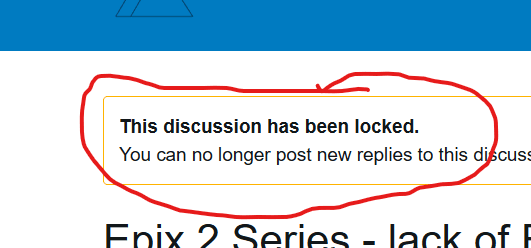
While it may not be outright censorship, Garmin is walking a fine line by restricting discussions on certain sensitive topics. This is evident in several forum threads that have been locked:
- https://forums.garmin.com/outdoor-recreation/outdoor-recreation/f/fenix-7-series/403230/f7—lack-of-feature-update-compared-to-fr-x55-x65
- https://forums.garmin.com/outdoor-recreation/outdoor-recreation/f/epix-2/403231/epix-2—lack-of-feature-update-compared-to-fr-x55-x65
- https://forums.garmin.com/outdoor-recreation/outdoor-recreation/f/fenix-7-series/392054/f7-series—lack-of-feature-update-compared-to-forerunner
- https://forums.garmin.com/outdoor-recreation/outdoor-recreation/f/epix-2/400296/epix-2-series—lack-of-feature-update-compared-to-forerunner
Once locked, a topic will quickly move from the forum’s first page. Presumably fading into obscurity.
The recurring theme? Frustration from high-paying Garmin customers who feel their newly purchased watches are quickly abandoned in terms of feature updates. While Garmin continues to release bug fixes and minor tweaks, major new features often stop rolling out soon after a watch’s release.
One Garmin customer and forum user contacted this site to say, “…I feel censored, Garmin closed these threads without any explanations and communication to its customers.”
This starkly contrasts Apple’s approach, where expensive watches receive software updates for as long as the hardware can support them. Many Garmin users—especially those migrating from Apple’s ecosystem—find this policy frustrating.
Why Is This Happening?
The simple answer is that Garmin is a profit-driven corporation accountable to shareholders and focuses on maximising revenue.
Garmin wants customers to:
- Buy more watches.
- Recommend their watches to friends.
- Upgrade to a new model as soon as possible.
One way to encourage some of this behaviour is by introducing planned redundancy—the perception that an older device is outdated, even if the hardware is still fully capable.
Apple’s Approach to Redundancy
Apple has similar financial goals but achieves planned redundancy more subtly — natural battery degradation.
Apple Watch batteries, like Garmin’s, have a relatively fixed number of charge cycles before their performance noticeably degrades. At some later point in time, the battery will need to be replaced. While Apple offers battery replacement, it comes at a cost—typically around $100 at a third-party repair store- with battery quality and workmanship risks. Apple’s replacement service costs slightly more, leading many users to trade in their Apple Watch instead. They will get about $100 trade-in for a typical old watch and save $100 on a new battery—effectively pushing them toward buying a newer model and saving around $200.
Garmin’s Approach to Redundancy
Garmin, however, cannot rely on battery degradation to drive upgrades.
- Garmin watches are far more power-efficient than Apple Watches.
- A Garmin watch battery might last 5–7 days per charge, compared to 1-2 day for an Apple Watch.
- Given similar battery chemistry, a Garmin watch battery lasts many years before needing replacement.
Because battery life isn’t an effective way for Garmin to encourage upgrades, Garmin uses artificial feature redundancy instead ie stop putting new features onto recent watches. What other choice does it have?
After one or two years, Garmin users may find themselves experiencing feature envy—watching newer models receive updates that their still-capable devices do not. While Apple users can expect years of software support, Garmin’s update cycle often leaves recent models behind much sooner.
This practice leads to frustration and backlash, especially from users who expect long-term feature support to be included in the premium price. What happens when those discussions on Garmin forums gain traction? Garmin’s forum moderators step in, limiting the conversation.
Takeaway
Garmin appears to be managing product lifecycles by intentionally limiting software updates for older models, pushing users toward upgrades through artificial feature redundancy rather than hardware failure. In contrast, Apple partially relies on battery degradation to drive new sales.
The frustration among users—especially those switching to Garmin from Apple’s ecosystem—is growing as they expect longer-term software support for premium-priced devices. When these concerns are voiced in Garmin’s forums, discussions are often shut down, raising questions about transparency and customer trust.
Perhaps the frustration is further exacerbated by Garmin customers subconsciously understanding that garmin is artificially doing this rather than the situation seemingly arising out of naturally ageing tech. Of course, those old enough to remember smartphones with non-user-replaceable batteries will realise that Apple is also doing this deliberately. It just feels less obvious.
I believe this topic is perhaps best suited to a Reddit thread, with Garmin’s forums left for product support.
Edit: After I posted this, the last two of the four forum threads were re-opened.
The amount of censorship is unknown because moderators can just deny a post and no one will ever know that someone tried to post something. I had situations that I had to rewrite my post multiple times before it was accepted on Garmin forum.
Not quite, apple do a Garmin more often than not and just stop updates to phones and watches on a whim and not when they can’t run the software as they are also a profile driven company.
Any can do this because the feature are so minimally updated they relay on changing the size more often then not to somehow show progress and give the same chip a different name
yes the chip naming is odd.
apple software (I’m thinking on the Watch) is pretty good for many models back. Only relatively recently was the AW3 taken off the update schedule
I’m glad you wrote about it. It’s a pity that DCrainmaker doesn’t write as boldly, although he commented on the lack of ECG for the same models as the lack of Garmin Coach update. Because the more famous reviewers write about it and publicize it, the faster Garmin will get a buzz and maybe then people will consider buying a watch from a company that wants to artificially force them to buy it again every year… I switched to Fenix 8, but the same fate awaits it. So I root for Garmin to learn a lesson and for revenues to drop drastically, and for Apple (because I think it’s the only one with a real chance) to threaten Garmin more. I love this ecosystem, but some bunch of idiots who are in power there are going a few steps too far and that’s why we have to say STOP!
His critique on these things is there but usually very toned down and not quite influencing the conclusion. He views these quality issue as minor quirks instead of viewing it as a “it’s a bold move to release something in this state and let people alpha test it”. He could definitely expect companies to do better.
It doesn’t help that he as a reviewer (like almost all of them) won’t come back to the products to see if or how broken the product’s a bit later.
it’s difficult to come back to products. It all takes so much time.
I make enough money from this to keep doing it but others make considerably more and perhaps could warrant the time to revisit products. But would I do it if I were in their shoes? probably not tbh, it’s not a very interesting thing to do but of course would be good for some readers.
I can see why reviewers don’t do it. It kinda costs them a lot of money at a point that less people care. But at the same time, that’s why the quality of the product at launch should play a bigger role.
Not easy trying to exchange with Garmin, this company is not in communication with its customer.
Even those are working for the community since years, they are a good list of powerful user that contribute to help and enhance the experience of the community.
Unfortunately, you are right SoCorsu… Wake-up Garmin and show us that you are capable to do this much better and user friendly!
From what I can tell 99$ gives you a first party battery replacement without apple care, not a third party one.
Garmin watches also aren’t that much more power efficient (if at all – and it depends on the metric), they just run slow in comparision and cut a lot of corners/convenience with turning off bluetooth/wifi/…, doing ECG only on-demand etc. to get there. Play music on a garmin watch and the battery runtime drops to the expected <1 day as their competitors.
Their software differentiation and their hardware differentiation is weird as well, though. Fewer price tiers, with different designs at each tier but more feature parity on each tier would be nice. And they still have room for improvement on the hardware/process/sensor side of things.
And tonight the original threads were unlocked, no words from Garmin …
Thanks for your article, for sure it helps to uncersored these threads !
As for DC Rainmaker mentioning anything like this, why would he bite the hand that feeds him? His reviews are for new watches, that just came out, not retrospective where “garmin is headed” type pieces. If he displeases the garmin gods metnining how this isn’t fair, they can easily cut off his feed of upcoming watches to test.
being unbiased is something to be…
being unbiased is something to be…
He runs a business after all.
Hmm, I guess I’m a bit perplexed by some comments here, given I was literally the first person to post about the lack of ECG going to the European Pro units when it happened. I called it out in the headline, I called it out in the post, and I’m the only one who actually bothered to reach out to Garmin PR and demand an on-record answer. Didn’t see anyone else doing that. Everyone else simply copied my post a few hours later.
I’m the only reviewer who’s held Garmin’s feet to the fire on countless things, including the recent Instinct 3 bugs/issues, the lack of updates to Venu series devices (mentioned constantly), and silliness of the Fenix/Instinct E series (we did an entire podcast dedicated to it, when numerous media outlets then parroted days/weeks later).
Ultimately though, my style isn’t clickbait and tabloid-style headlines, no matter the company. Yet, it’s also clear from the above, people aren’t actually reading what I wrote/say/whatever. Which is fine, but just don’t complain that I’m not doing anything when I clearly am.
Ray, Des and Matt are providing some of the most detailed reviews out there. And all 3 mention in their videos, articles and podcasts what is wrong with Garmin products, especially the F8 and I3. Matt just posted a long video titled 100 day with the F8 and he points out that an upgarde to the F8 is unneccessary unless you want the diving activities and/or the microphone. So all the people who are bashing them should take the time to read and listen what is published…and if your English is not good enough to understand what is being said, there is always google translate!
I just wrote that you created an entry about ECG and talked to Garmin. And I know that many other entries did as well, for which I respect you.. However, this language is extremely diplomatic, instead of being sharp and critical, even offensive towards decision-makers. Because some things have to be called by their name. Such a large company has to be pressed hard, aggressively and done en masse. As a beta tester for many years, of many Garmin watches one after another, I have little to say. But I see what is happening on Garmin’s forum, as well as in Facebook groups, where I am a moderator or administrator. I know a lot about the equipment I use. But even for me, as a Garmin supporter and enthusiast of their equipment, it is hard to speak and write loudly, supporting what Garmin is doing. I think things are going badly there in power and it should be criticized. Although I have discussed errors and problems in many messages, including private ones with the admins on the forum – Kelly, Lourie, Cris, Mellody, they themselves also have their hands tied. However, the branch in my country washes its hands of it because they have no say in the matter. That is why the collective show of strength of the users themselves is so important. What Garmin has done in the last six months, i.e. since the debut of the Fenix 8 series, is subject to the competition and consumer protection authorities in many respects. I can find not 100, not 500, not 1000, but more people for whom the Fenix 7 and 7 Pro and Epix series work worse and worse with each new update. And the very fact that Farmon branches are still encouraging people to buy Fenix 7 Pro and Epix 2 Pro, and behind their backs on an international forum, they are making the biggest mess possible in the history of this company, and discriminating against owners of the most expensive Garmin watches, is worthy of a paragraph and criminal proceedings. The people responsible for this should be held legally and financially accountable, because it is a clear action to the detriment of the customer.
Hi, for sure your article are rugged tests and objectively commented.
I always comment under each articles to share my thoughts and information, sometimes try to tag you on the Garmin forum too.
Garmin Rumors also write some short articles about this situation. Like 5krunner and all specialized sites, thanks for testing and sharing your work !
Regards,
Kudos for all that you’ve done. But you haven’t held Garmin to account for messing up its wrist HR sensor, a problem many posters have with different Garmin models. It’s not a problem of wrist sensors in general, or even Garmin wrist sensors, until a few firmware updates ago.
In my (still unfulfilled) quest to restore this basic watch functionality, I found even ChatGPT was aware of it, identifying the problem beginning with update 15.77, and exacerbated with following updates. When my effort to downgrade to that version failed, ChatGPT identified that my Epic Gen 2 was an early version that required firmware 13.22 as the workaround, and provided me a link to it. I’m still considering whether a functional wrist HR sensor is worth sacrificing all the subsequent updates. Of course, Garmin could do the right thing… .
hi Brian
thank you for your comment
You might be best to ask Ray on his site for help or the official Garmin forums or Garmin support (I’m sure you’ve done all of those but thought I’d mention it just in case not).
As we all know Garmin watches can be buggy, the problem you cite must be very frustrating and it appears to be a fundamental bug. I don’t think it’s Ray’s job to chase this up (though he might)…where would it end?
I don’t have any trouble with Garmin’s approach. I pay money for a set of features on a given date, and if that’s all I get that’s fine, I knew what I was getting and no promises were made. As their watches get “smarter” and handle more sensitive data though the question of security updates might get more relevant though.
Also I’m surprised they allow such open criticism in their own forums to begin with, some quite vicious.
Reviewers are more than wiling to help manufacturers with feature envy. This site is an exception but other well known reviewers you will not find saying a new function isn’t useful at all, or is half baked (although that might differ per brand they review)
thank you for your kind comment! I appreciate it.
It is tricky though with new features. I *DO* like a new feature and find developments in sports tech interesting. I *DO* like using the new features. I *DO* like writing about them. I try to give an opinion (which may well be wrong) about the features’ usefulness and possible flaws.
I guess it’s rare that a new feature fundamentally changes how I train or race, and many of the features turn out to be toys to play with rather than real productivity enhancers or fitness enhancers. I suppose that’s fine.
Garmin’s ClimbPro is a great example of one of the game-changers, as are Varia Radar and Coros’s Track mode too.
but even simple features like Garmin auto-start for the next active swim set are mini game changers (same with auto transition if implemented for indoor bricks)
I find it a bit sad that features like Suunto’s DDFA *COULD* be game changers but aren’t adopted in a mainstream way. That’s probably one feature that could change the efficiency of training for tens or hundreds of thousands of athletes, making them properly execute Z2 training. A related feature woudl be some of the clever stuff Fourth Frontier X2 does…that could literally save hundreds/thousands of lives if you look at the efficacy of screening programs
I have a Bryton since a couple of months. It doesn’t work in the Netherlands. I was hoping it would warn me of upcoming cyclist or once that ride close behind you to use the drag (I don’t mind, as long as I know it)
But all bike riders need at least 10k/h difference in speed and on the bikepath in the Netherlands you don’t get that very often. Even dc, who lived in the Netherlands for quite some time, doesn’t mention this. What reviewers do mention is that the bryton can ‘only’ see object at max 120k speed difference and garmin up to 160k, so garmin is better. Really? Is that a problem? If cars are driving at 150k/h (30k of bike + 120k speed difference) you’re biking on the wrong road!
Glad I didn’t bought an overpriced garmin varia.
And training on a track is easy. I train every week on a track at my athletics club. We usually do shorter intervals on a track (between 200 and 800m). You know the distance on a track, you know what times you have to run on each interval. All you need is a stopwatch.
It’s probably me, but if I look back at strava, I can recognize the intervals and the rest periods. If my watch reports a 400 interval as 420 (due to gps inaccuracy) that’s alright, as long as the time is around 1:32.
My training will be no different if the watch reports 400m and I don’t miss trackmode on my old forerunner 965 now that I have a Suunto Race s. I only used it once or twice and concluded it didn’t add anything for me.
But maybe I miss something important
“Even dc, who lived in the Netherlands for quite some time, doesn’t mention this”
Except, umm I did mention exactly this, word for word, in my Bryton radar review, saying: “Bryton isn’t quite as good at this as the Varia though, and seems to disappear steady-state cars more quickly than Garmin does – often giving the all clear when in reality the coast is very much not clear. Here’s an example of that working poorly on Bryton, but better on Garmin, at 4:15.”
I talk about bikes and how that works in the paragraph before it, even showing bikes coming up in the video. Did you even read any of it?
@dcrainmaker. Please read. I’m not talking about cars. I’m talking about bikes that creep up on you. Like I said, I don’t mind someone using my drag, as long as I know it so I can warn people. No radar warns you for bikers. Not bryton, not garmin.
Take it easy dc. Your reviews are fine, just not for me. I use my watches and other stuff in a different way than you review. That’s all.
Garmin swim auto start wasn’t a game changer, it was a straight copy of a Polar feature from years before on the Vantage V
And here is an other example of garmi trying to suppress angry costomers:
https://forums.garmin.com/sports-fitness/running-multisport/f/forerunner-965/374071/voice-prompts-for-turns-during-course-navigation—turn-off/1845999#1845999
(Garmin added forced voice alerts for tbt alerts, which cannot be turned off. For my, that was the final push for my away of garmin.)
So you blame Ray for not telling you that the Varia or Bryton radar is NOT warning you that bikes are behind you because you are to lazy to read what is written on the official websites? Sounds more like a you problem!!
I don’t blame anyone. At best I tell reviewers their review is incomplete. And incomplete for me that is, and I can perfectly understand they don’t write reviews specific for me.
I do blame everyone not making clear why there is a ‘peloton’ mode if the device is not capable of detecting if someone is cycling within 1 meter of the device. Either peloton mode is useless, or the device is broken.
But don’t worry. I stopped reading reviews I know are more focussed on describing featurelists and less on usefulness (in my views, your views maybe different) so I won’t comment the well known reviewers anymore.
Well seeing what Garmin does with its bug ridden quarterly updates, I would rather have a watch with a set of features that I’ve had since launch than having to browse forums before each firmware update to see, what did they screw up this time. So lack of new features is not a problem, as long as they don’t break the core functionality of the watch.
Worst than not bringing new features is even the few fixes on beta that are reported are not fixed
The last betas totally screw HRM functionality even when you use a HRM Pro from Garmin itself don’t work anymore and after 2 or 3 iterations of beta never get fixed…. so yeah totally lost at moment with so many devices
And yesterday Fenix 7 Series received Beta 20.16, only to activate ECG during “beta”, this is the sign of a Release Candidate or Live version.
then no fix for many issues reported, as usual ………………….. 🙁
Suunto does the same way since long time.
I’m sure most companies do it.
The interesting thing is the topic rather than the company per se.
Also this thread was castrated and removed some of the posts without any explicit notes from mods that they deleted them: https://forums.garmin.com/outdoor-recreation/outdoor-recreation/f/fenix-7-series/402253/what-are-you-doing-to-stabilize-our-1000-devices-garmin
The post were about the Blue Triangle death.
It is funny to see that posts with a swearing tone can remain, but ones with irony/sarcasm have to be deleted.
I dont know whether you can see it, but https://forums.garmin.com/cfs-file/__key/conversationfiles/b5b6a81c-91cc-46dc-a674-d2a0ba937571/RDT_5F00_20250129_5F00_0852415260895320244371512_7E00_2.jpg
And my way of mocking:
Let me tell you a short tale. It is a tale, but true. Only the real names have been changed to protect the heroes.
Once upon a time, more concretely in the 1970s,, there was a child in an unspecified country. in this country knowledge was a big, big, big value. Young kids were being taught by their enthusiastic parents to make them understand many many things iin the word ncluding basic ones like maths and logics.
One of the tools these parents used was a simple logical consisting of geometrical shapes in different colours and in two sizes sizes. Some of them had a small hole in the middle, some of them did not. The number of items were 3*4*2*2=48.
See szegoszolnok.com/…/logikai_keszlet.pdf
This tool developed the mind of the young brats.
The aforementioned child loved this mathematical/logical tool soooo much. And yes, his favorite combination of shape and colour and size was the f***ing big BLUE TRIANGLE!
🙂
great punch line
A forum mate’s best ever picture about blue triangle, which was deleted by Garmin twice: https://ibb.co/CKYmnJbf
🙂
i’ve seen similar !