


Has Garmin Messed Up with Instinct 3 and Instinct E?
In 2018, you got the impression that Garmin had half-heartedly tried to make a cheaper, rugged Fenix or, perhaps, a more highly featured competitor to the Casio style of rugged outdoor adventure watch. Whatever the intention or motivation, the company struck gold, and Instinct sold like hotcakes and quickly built a loyal following.
More: Garmin Instinct 3 Review – full and detailed
As the years passed, Garmin sought to differentiate Instinct for customer segments with new sizes, features, improved tech, and unique variants for new customers like gamers.
Key Milestones in the History of the Garmin Instinct:
- 2018 – Initial Release: Built to military standard MIL-STD-810G, it featured a fibre-reinforced polymer case, GPS navigation, heart rate monitoring, GLONASS support, and a barometric altimeter. The watch’s design was robust, with a readable monochrome display.
- 2019 – Instinct Tactical Edition tailored for military and tactical operations, adding unique features such as Night Vision Goggle compatibility, Jumpmaster mode (for skydiving), and Stealth mode.
- 2020 – Instinct Solar included solar charging capabilities, significantly extending battery life, making it more suited for long outdoor adventures, hiking, and remote expeditions.
- 2021 – Instinct 2 Series brought improvements, such as a colour display, battery life, and new design options. The Instinct 2 offered multiple variants, including a smaller Instinct 2s and Instinct 2 Solar.
- 2023 – Instinct 2x Solar was a larger model with enhanced features like a larger display, multi-band GPS, and improved heart rate tracking.
- 2025 – Garmin Instinct 3 AMOLED brought Instinct’s first pretty screen, whereas the 3 Solar model offered customers seeking unlimited battery life a market-leading option. A cut-down Instinct E offering was also added, and an Instinct 3 Tactical in April 2025.
Superficially, the 2025 models seem to take Instinct in a sensible direction. A base model priced at $300 seems reasonable for a premium brand like Garmin, and the most expensive 50mm AMOLED model’s $500 pricing is kept well away from the base Fenix E model at $800.
However, there are problems when you compare Garmin’s latest Instinct models with older Instincts and the capabilities of watches at similar price points.
Garmin Instinct E (40mm, 45mm – $300)
Instinct E retains the traditional look but with some case design improvements. Check out the evolution of the design in the following images and wonder why the red lines are needed around the edge of the latest display.
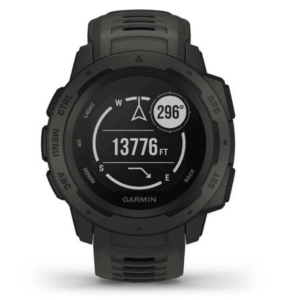

- Design: It is a rejigged Instinct 2 with some hardware tweaks, plus feature downgrades back to the level of the original Instinct 1 (I doubt it has any notable Instinct 1 hardware components)
- Pricing: At $299, it’s priced identically to Instinct 2.


- Features: Lacks the torch of Instinct 3 and doesn’t provide compelling value to outdoorsy types compared to its predecessor or similarly priced alternatives.
Garmin Instinct 3 Solar (45mm – $400, 50mm – $450)
- Minimal Upgrades: While it improves solar charging efficiency and display readability, it doesn’t offer significant advancements over the Instinct 2 Solar.
- No Major Hardware Enhancements: It retains the old Gen 4 heart rate sensor.
- Lack of Maps: A $450 outdoor-focused watch without maps feels like a missed opportunity. The solar feature assumes explicitly that the owner will be outdoors for extended periods. It is reasonable to assume many will be involved with navigating.
- Overpriced: The price is unchanged from Instinct 2, 2X, but old models on sale are cheaper, and other brands provide maps at this price.
Garmin Instinct 3 AMOLED (45mm – $450, 50mm – $500)
The first Instinct with AMOLED. The small circular status screen is integrated into the appearance of some screens. There is only one display.
- No Touchscreen: An omission for a watch with an AMOLED display.
- Lack of Maps: A $500 outdoor-focused watch without maps feels like an outlier compared to other watches at this price, and older Garmin models provide the feature.
- Missing Hardware Enhancements: It retains the Gen 4 heart rate sensor but does get SatIQ and a new GNSS chip.
- Interface Inconsistency: Its user interface differs from the improved usability of the Fenix 8 – an interface standard many had assumed Garmin would universally adopt in new models. Nope.
- High Price Point: The lack of standout features like maps or a touchscreen makes the price more challenging to justify against other brands at the same price.
Q: Could or should Garmin have added maps?
A1: Garmin has the ability to add maps. It was a conscious decision to omit them.
A2: The new Instinct watches lack the space to accommodate Garmin’s maps as they are normally implemented, so Garmin has no plans to add maps (you can use dwmap).
A3: Long-battery life, durable outdoor watches are intended for people who would probably find maps useful
A4: The $300 price gap to Instinct E is non-trivial. Adding maps probably would not have impacted Instinct E sales.
A5: Yes.
Take Out
Yes, there are issues with the pricing and features, but if you assume someone wants to buy a rugged, feature-packed Casio-like smartwatch, what are the alternatives to Garmin?
A: There aren’t any.
Garmin is thinking long and hard about the strategic positioning of Instinct and Fenix into the future, introducing many points of difference, the most obvious being maps, displays, solar, heart rate sensors, user interfaces, GNSS chipsets, and features.
Even when the new range of Fenix 8 and Fenix E are discounted in future sales, the pricing shouldn’t encroach on Instinct’s territory and the old stock of Epix 2/2 Pro will long since have been sold.
I suspect Garmin assumes a natural $50-$100 premium for its brand and Connect ecosystem. With that assumption, you might argue that Instinct E is worth $200 ($299-$100) for comparative purposes – a quick look at the sky-high Casio G-Shock pricing shows what great value Instinct E is (hmmm)
So Garmin’s positioning with the new Instinct is all very logical from one perspective.
However, from the customer’s perspective, you get two obvious and immediate complaints
- $500 and no maps! You must be kidding. It’s 2025.
- I’ve been a loyal Instinct owner for several years, and your latest model doesn’t offer the newest menu interface and HR tech. I might not wait until 2027 to upgrade.
Garmin could direct you to check the features of other brands you are considering switching to, stressing its ecosystem is superior. After a long, hard think, I suspect few people will jump ship from Garmin, but by the same token, I expect only a small proportion of existing Instinct owners will upgrade soon.
Instinct will do well but might underperform Garmin’s internal expectations.
Buy Instinct
The Garmin Instinct 3 series is available to order now with delivery after 10 January 2025
- Order: Garmin Instinct 3 SOLAR
- Order: Garmin Instinct 3 AMOLED
- Order: Garmin Instinct E
If you visit the Garmin website and look at the pictures of the new Instinct, Garmin did not have the gritty outdoors man in mind when designing this watch. The people in the pictures look like a bunch of mediocre GenZ tiktok influencers…Not necessarily the crowd that needs unlimited battery or maps to navigate the wild.
I think a lot of people will hold on to their older Instincts (I owned the Instinct, the 2 and the 2X over the years and was hoping for AMOLED) or buy much cheaper 2s on the second hand market, unless they really want a nicer display and don’t care about the price and the missing features (like I do). New and old ones will be around for years to come.
yep.
very good point on the garmin imagery. i had noticed that but hadn’t thought it through.
This article feels rushed.
Garmin are on point with the new Instinct line, including their pricing.
You forgot to mention the torch that’s now available on all Instinct 3 models, except Instinct E. No other competitor has this feature, and only Garmin’s older 2X had this, now we finally get it in a smaller casing. Another great feature is Garmin Pay, not many competitors have this feature on a similar watch for the price.
Maps – I’ve seen many Instinct on wrists of people and I ask if they use the map, none do as it’s annoying without a touchscreen.
No touchscreen on the instinct – well that’s what the Fenix is for, and if the Fenix 8 is too expensive then buy the Fenix 7, which is still more expensive than the Instinct 3.
You mention the high price making it hard to justify compared to the competition, but then go on to say, there’s no competition, well…
Older heart rate sensor – what was wrong with the old one? In all the reviews I’ve seen not once did anyone have a major problem with the sensor’s accuracy.
Older models offer better value – of course! If every company based their pricing on the future discounts of older models they’d be out of business.
The instinct didn’t have maps in the past, so if you asked them they couldn’t say they use it. Also what about the mandatory orange accent on the bezel if you choose MIP?
There is indeed problem with the accuracy, but only when it’s colder, which most reviewers don’t cover. My hand is cold here in mid Europe 6 months of the year and it performs much worse – DC Rainmaker said V5 fixes this.
Also no hill score and no endurance score – it should have been there, who needs hill score if not instinct users?
Btw they wouldn’t have hurt any Fenix sale if they included Fenix 2 style maps, and it was useful still, I used it a lot back then.
They messed it up and basically don’t care about the original target audience any more.
optical HR results are personal depending on physiology, environment and usage
there are issues in the cold as you say and also issues with hrv.
i’ve added the torch, I have mentioned it in other articles.
i’ll revise the wording of alternatives/competitors/direct competitors
maps are available via dwmap (or very soon will be as i spoke with the developer)
“This article feels rushed.”
From a Garmin perspective, it certainly does, because it points out the obvious flaws of this release. But apart from the flashlight added to the smaller cases, I think you are mostly wrong. The flashlight is obviously an awesome add-on. I’ve bee using it for years on Fenix, Enduro, Instinct 2X and now my Epix Pro and I don’t want to miss it. In fact, I barely wear my Marq in the Winter season because the display version of the flashlight is just paltry.
The fact that you’ve asked many Instinct owner about maps and you got a negative reply, is obvious and we don’t have to elaborate that statement any further.
The HR sensor is another issue….why in the world would you sell a next generation watch with an old sensor when the Venue 3, which came out a year or so ago, has the E5 sensor and is way cheaper (Not on Garmin’s website, but I could get a new one online for as low as 379€ right now)
The fact that Garmin sells an AMOLED watch without a touchscreen and maps is a missed opportunity and I would venture to say that many people will not upgrade from I2 or I2X, especially not in this economy unless they want a shiny display and a flashlight. I would get an AMOLED version once I find one discounted (new or used) by 25-30%. But unless that happens or Garmin will issue a Tactical version with maps (most unlikely COA)…I’ll safe my money and wait for the Fenix 8 Pro/9/ microled display and/or the I4 with better HR sensor and maps. I’m extremly disappointed because I wanted an AMOLED Instinct…but not at this price
I think the mandatory orange accents on the solar model, as well as the lack of choice in other colours (other than a weird mishmash), was the biggest disappointment for me. I like an understated watch… either mostly black or dark grey, and if it absolutely had to have accents then black with the carbon grey like the Fenix line is great. But bright orange… I’ll keep my black Instinct Solar Tactical! No reason to upgrade yet in my opinion based on either colour or features (I don’t want an AMOLED screen). Also, the lack of a 40mm size other than the pared down E model feels like a miss.
i’ve been a recent convert to ‘orange’.
however the essence of your point is correct. how on Earth can most people want ornge? strange default design choice when there are no/few colour options.
Orange is very commonly associated with mountaineering and the outdoors so it’s easy to see why they decided on that colour. Same reason the Apple Watch Ultra has an Orange Action button. Safety Orange as its known by the Swiss Brand Mammut!
Is screen in Instinct E same as in Instinct 3? Same contrast, viewing angles, backlight? Or is it the same as was in Instinct 2?